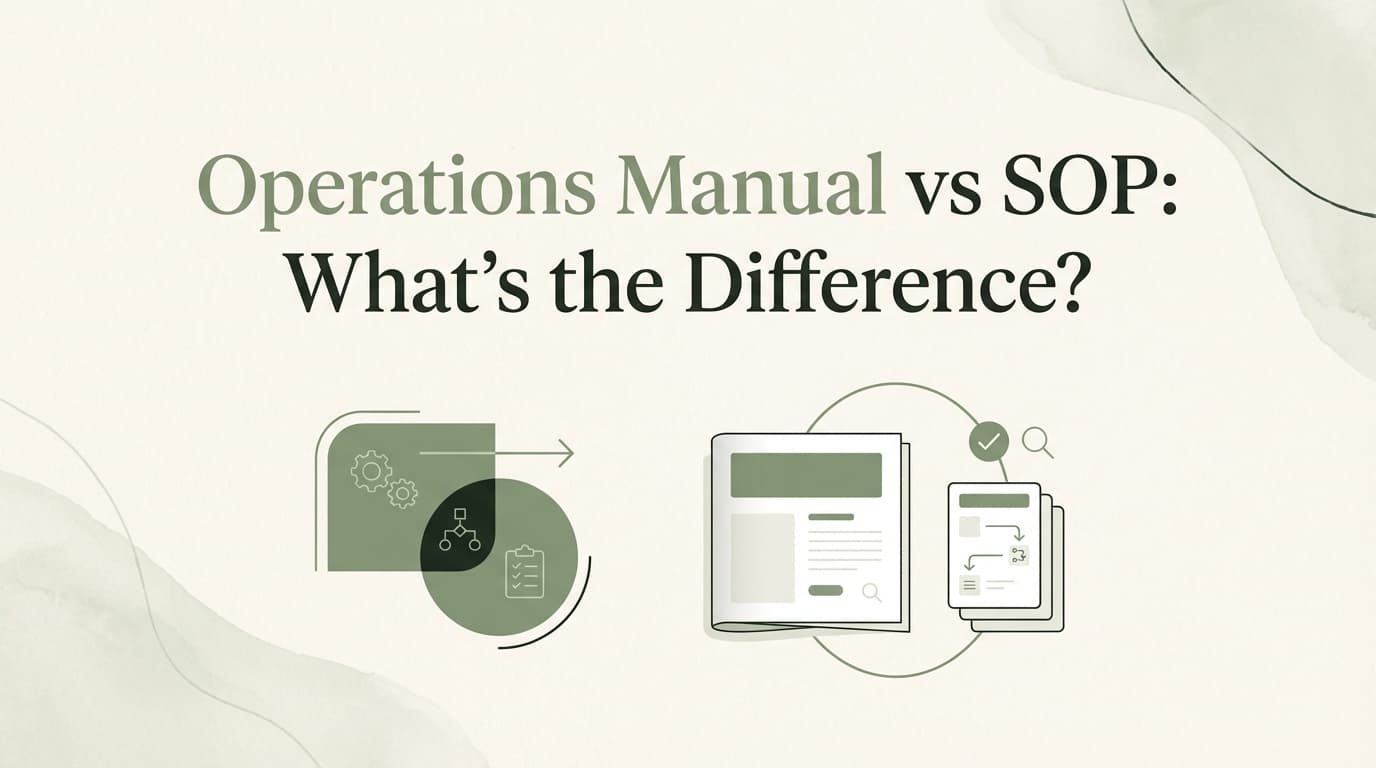
Operations Manual vs SOP: What’s the Difference?
Teams usually get this topic wrong for a simple reason: they are using one label for several different documentation jobs. That leads to bloated documents, duplicate content, and confusion about where the real source of truth lives.
Definitions
Operations Manual
A top-level operating reference that organizes policies, roles, linked procedures, and governance for a team or business unit.
Best fit: Creating the structure of a documentation system.
SOP
A task or process procedure that tells someone exactly how to perform recurring work.
Best fit: Executing the repeatable work inside the system.
Quick Comparison
| Format | What It Is | Best For |
|---|---|---|
| Operations Manual | A top-level operating reference that organizes policies, roles, linked procedures, and governance for a team or business unit. | Creating the structure of a documentation system |
| SOP | A task or process procedure that tells someone exactly how to perform recurring work. | Executing the repeatable work inside the system |
The practical rule is simple. If the reader needs exact execution steps, use an SOP or work instruction. If the reader needs scenario guidance, principles, and linked procedures, a playbook is usually the better wrapper. If the workflow is event-driven or incident-based, a runbook often fits better.
How to Choose the Right Format
Ask these questions:
- Is the work triggered by an event, alert, or incident?
- Does the reader need exact steps or broader judgment guidance?
- Are multiple related procedures being packaged into one reference asset?
- Does the document need clear owners, approvals, and scope boundaries?
Those answers usually tell you which format belongs at the center and which formats should be linked beneath it.
Common Scenarios
The easiest way to choose is to map the format to the actual operational situation:
- If the reader is responding to an alert, outage, or event, start with the runbook.
- If the reader needs one consistent way to execute recurring work, start with the SOP.
- If the reader needs principles, scenarios, examples, and linked procedures, start with the playbook.
Many teams need all of them, but they need them at different layers of the documentation system.
A Simple Decision Rule
If you are still stuck, use this shortcut:
- choose the document that matches the reader’s moment of need
- choose the narrowest format that still captures the right level of context
- link adjacent formats instead of merging them into one oversized page
That keeps the system navigable for both humans and search engines.
Where Teams Go Wrong
- copying the same steps into the manual and the SOP
- trying to use the manual as a single-document answer for every workflow
- failing to define where a team should look first when they need help
A Practical Documentation Stack
Many teams work best with a layered system:
- A high-level manual or playbook for navigation and context
- SOPs for repeatable cross-functional processes
- Work instructions for task-level execution
- Runbooks for incidents, alerts, or event-driven operations
This is one reason capture tools are useful. A tool like Glyde is strongest at the task layer, where people need clear, visual instructions. That generated content can then be linked inside a broader manual, playbook, or runbook system.
When to Use More Than One Format
This is the part many teams miss. The right answer is often not choosing one document type forever. It is choosing which one is primary and which ones support it.
For example, a support organization might have:
- a playbook for escalation philosophy and service standards
- SOPs for ticket routing and handoff procedures
- runbooks for incidents and outages
That system is easier to maintain than a single oversized document trying to cover every layer at once.
Learn More
For a complete framework, see our guide on the complete guide to standard operating procedures.
Related Resources
- If you are building the library from scratch, start with how to document a process and how to write an SOP.
- For software-heavy workflows, recording the process once and turning it into an SOP is usually faster than writing from a blank page.
- See also: Operations Manual Template for Growing Teams.
- See also: Runbook vs SOP vs Playbook.
FAQ
Does every team need an operations manual?
Not always. Small teams can start with a lightweight documentation index, then formalize an operations manual as the number of procedures and owners grows.
What is the simplest structure that works?
A manual or central index for navigation, linked SOPs for process execution, and work instructions for narrow software tasks.